Dane Rudhyar

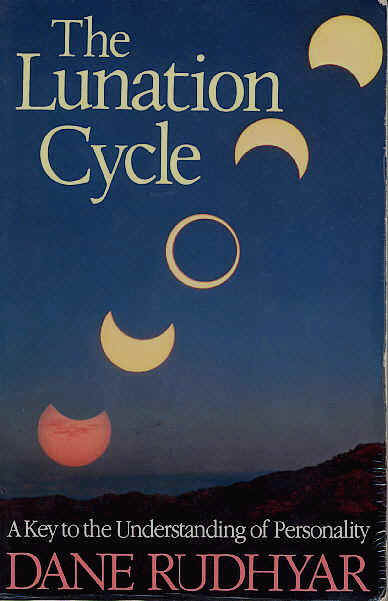
This pioneering classic provides a new dimension in the use of Astrology as a powerful tool in understanding life patterns. The Lunation Cycle is a unique technical breakthrough revealing the significance of the cyclic relationship of the Sun and Moon as phases of a larger process. Rudhyar formulates and describes here for the first time, the eight Soli-Lunar types of personalities and the importance of the New Moon Before Birth and the Progressed New Moon charts.

This ground-breaking book includes: 

                    The Sun and Moon as a dynamic pattern of relationship.

                            The Part of Fortune as an index of personality and happiness.

                The Part of Fortune in the houses and zodiacal signs.

    The Planets in relation to the Lunation Cycle.

Rudhyar's innovative presentation of the Progressed Lunation Cycle is an invaluable technique providing insight into how to use all life events in the actualization of inner potentials. The meaning of specific events are viewed as an ordered series of Lunation phases, with the context of your whole life pattern, from birth to death. This is a practical and clear way to anticipate major turning points and transition periods, and to understand our individual schedules of unfoldment. 


*

ASTROLOGY, TIME & CYCLES

Astrology, A Technique for the Study of Life Cycles:

Astrology can be defined as a technique for the study of life-cycles. It's main purpose is to establish the existence of regular patterns in the sequence of events constituting a person's inner and outer experience; then, to use the knowledge of these patterns in order to control or give meaning to these experiences. As people learn to control the genesis, development and recurrence of their experiences, they achieve mastery. This is the goal of the 'adept' or the scientist - a goal which deals with the accurate timing of actions and the adjustment to expected reactions. On the other hand, as people give meaning to their experiences by referring them to the cycles of their individual being or of humanity at large, they develop a conscious and inclusive attitude to life. They gain understanding and wisdom, which is the goal of the philosopher. Indeed, the study of cycles - that is, of periodical activities in nature, human and otherwise - is the root of all significant knowledge, be it scientific or philosophical. And the study of cycles is a study of time.     

There has been much unnecessary confusion as to the nature of time. And the confusion originates mainly in the failure to differentiate between 'generic' time and 'individual' time. Generic time - objective time - is the time measured by the calendar and by clocks; the time which makes the peasant plow the field, and reap the harvest, which establishes the normal, natural rhythm of biological functions in human bodies. It is the very matrix into which the common activities of human beings flow. Just as the social activities and common reactions to life of the average person are structured by the cultural-religious traditions and the laws of their country, likewise, at a still more basic level, people's generic activities and their objective sense of time is structured by celestial cycles. The latter not only serve to 'measure' time; they are the very substance of generic time. And the fundamental characteristic of this time, of which all of us are compelled to be aware, is that it is cyclic. It is cyclic because it is established by periodical changes in the cosmic environment of humankind - that is, by the ordered activities of cosmic wholes, of which our globe is only a very small part.     

Beside this objective time, valid for all human beings, there is an individual time, which is experienced by individual entities as subjective duration. It is experienced as a normally unconscious, organic psychic feeling; and this feeling eludes standardization, depending as it does upon the more or less individualized rhythm of the experiencer and upon particular, unduplicatable conditions. Subjective duration is a resultant of the state of organic wholeness. It is an expression of the particular rhythm of a particular organic whole functioning truly as a whole and not merely as part of a larger whole.     

At the level of strictly animal life, duration is an expression of the rhythm of the entire species rather than of the rhythm of a particular specimen thereof; this, because  individual characteristics reside in the species and not in the individual organisms manifesting the species' biological characteristics. With human beings, however, as the process of individualization begins to operate and a particular man or woman develops increasingly individual (thus, relatively unique) characteristics - biological and, above all, psychological - 'individual time' begins to be felt. Felt at first in the dim, almost poignant way in which the first longings of adolescence reach the consciousness, this sense of subjective duration becomes sharper, the more the person functions as an individual. Moments of great emotional stress - of intense living or 'dying' - arouse this latent realization; but techniques have also been devised deliberately to induce and accelerate such an inner development. Hindu yoga is a typical example of such a conscious effort to individualize time - a result obtained by the control of organic energies and by a refocusing of the ego.     

The co-existence of objective time and subjective duration in the consciousness of the individualized human person produces at a certain stage of evolution a deep-seated inner conflict. This conflict is parallel to, and a function  of the struggle between the collective and the individual factors of the personality; between the desire to participate in, or be subservient to, collective and social patterns, and the will to express one's unique identity; between the inbred realization that one is a part of a large whole (society or mankind) and the innermost feeling that one is a whole, unique and self-sufficient.

Astronomy and all precise sciences deal solely with objective time - clock time - regulated by a universally accepted standard. This standard is fundamentally the sidereal day, the period between two successive returns of a star to the meridian - the time needed for a complete daily rotation of the earth around its axis.     

Astrology, in so far as it is based on astronomical data, deals also with objective time and its cycles. But astrology is not merely a study of celestial cycles in themselves; it is a technique of interpretation of the meaning of these cycles with reference to the possibilities for growth in individuals. It does not - or should not - deal with compulsions of generic, cosmic fate; but, instead, with the opportunities which the individual has to emerge from the compelling, structuring matrix of objective time into the creative freedom of subjective duration.    

Astrology can be understood as a technique for the discovery of one's own individual structure of being. And this structure is the foundation of individual immortality; for immortality is the power to dwell in a world of one's individual making, and to hold the structure of that world intact (and one's creative thought-powers firmly established within it), even against the shock of disintegration of the biological organism which we call death. Immortality is the victory of subjective duration over objective time. It is the triumph of the consciousness of being a whole with a unique identity over the consciousness of being merely a part of the human species subject to generic and social patterns of living and behavior.     

The individual birth-chart, erected for the exact first moment of independent existence as a living organism (the first breath), is a cosmic symbol of the individual structure of being.

But an Astrologer (or one's self) must be able to see it as such! If one thinks of the birth-chart as the mere reading of a clock of objective time for a particular moment; if they add up the positions of the Sun , the Moon and the planets as a person looking at a clock adds up the indications given by the hour, the minute and the second hands; then, what the they discover is only the sum-total of compulsions which the newborn must meet according to the laws of action and reaction of their generic human nature. Indeed the newborn is seen, then, as merely a combination of natural drives, ancestral tendencies and unavoidable allegiances to environmental patterns.

If, on the other hand, one is able to visualize the entire birth-chart as an individual and indivisible structure revealing the potentiality of manifestation of a unique and original identity, creative of its own subjective duration and establishing the beginning of its own era - dawning point of its immortality - then, one can perform a spiritual function. They evoke and summon forth the image of the wholeness of the person whose birth-chart they study. This is a spiritual act because spirit deals only with wholes. Spirit is the wholeness of every living whole; and it is, in its operations, that which ever tends to reestablish wholeness, balance, harmony, integration, health, plenitude of being - wherever there is the consciousness of lack, of need, of greatness yet unrealized, of fullness yet unattained. . .and, at the same time, the faith which alone can open the gates of the empty structure to the inrushing tide of spiritual abundance.

Objective time establishes limitations and boundaries for human beings because it is the product of the activities of vast celestial cosmic bodies within the electro-magnetic fields of which humans appear as a most unimportant part. The position of the Sun, or the Moon, or any one planet or star in a birth-chart represents, therefore, the particular kind of subservience the person experiences in relation to the natural energies symbolized by the cyclic motion of this one celestial body productive of objective time. Likewise as a child is born into a certain family belonging to a certain social class, this fact indicates his subservience to the particular kind of social prejudice or preferment which is associated with that class. It is a limiting fact. To be born on July 30th of any year is a limiting fact. It establishes one's particular mode of subservience to  the factor of solar vitality - the Leo kind of response to this solar vitality.     

If, however, the birth-chart is seen as a whole - as the 'Name' of the individual-in-the-making - the wholeness of it represents the particular potentiality of freedom of the person from this, that or the other natural energy and social prejudice which tend to clock their reactions to life. To see the birth-chart as a whole means seeing it as a complex relationship between the many factors it contains: planets, cusps, nodes, parts, etc. A sum-total is not a relationship. To add up the indications given by separate factors has statistical value; it has no spiritual meaning. Spiritual meaning is an expression of relatedness.

Likewise, a tone produced be a great musician on a violin is a complex entity, composed of many overtones, each of which has a particular frequency, dynamic intensity, phase, etc. When we hear the tone, we hear an organic synthesis of all these component sound-vibrations, and what we call the 'timbre,' the moving quality, the emotional power of the tone are the results of the relatedness of all these sound-vibrations. This is the 'character' of the tone; just as the character of an individual is an expression of the relatedness of all the constituent parts of their total being. And character is creative freedom.


*

THE TWO BASIC KINDS OF ASTROLOGICAL

ASPECTS AND CYCLES

The above considerations constitute a philosophical introduction to the study of what the astrologer calls 'aspects'. If a person is born with the Sun at Aries, 1st degree, and the Moon at Cancer, 1st degree, the astrologer says that the person was born with a 'square' of the Sun and Moon. What this means in intellectual and geometrical analysis, is that the positions in zodiacal longitude of the Sun and Moon formed a 90 degree angle with reference to the center of the earth. If the angle had measured to 120 degrees, the aspect would have been called a 'trine'; if 60 degrees, a 'sextile'; if 45 degrees, a 'semi-square'. If the two celestial bodies are on either side  of the earth (as far as their longitudes are concerned) and thus on two opposite points of the zodiac, the aspect between them is an 'opposition'. And if the two bodies are found on the same degree of the zodiac, they are said to be in 'conjunction'.

This of course is elementary astrological - and astronomical - knowledge. Every student of astrology knows also that when the angular relationship of two planets is less or more than a few degrees different from the exact values mentioned above, it is still necessary to consider it an aspect. If the Sun was at Aries, 1st degree, and the Moon at Gemini, 27th degree, or at Cancer, 7th degree, they would still be 'within orb' of a square aspect - the orb allowed depending mostly on the speed at which the various planets move.

What is not usually very clear in the mind of persons interested in astrology, is the difference there is between the indications derived from (1) the zodiacal or house position of a planet, and (2) the aspects between two or more celestial bodies.

Indications of the former type deal with particular moments in the cycle of motion of the one celestial body considered, this cycle being studied with reference to some static earth factor. To say that a person was born with the Sun at Libra, 1st degree, means that the Sun had then covered half of the time it takes to move every year from one vernal equinox to the next; and the vernal equinox is the conventional beginning, with reference to the plane of the earth's equator, of the yearly cycle of the Sun's apparent motion in the sky. Likewise, the position of a planet in the seventh house of a birth-chart means that this planet has described half of its daily circuit of the sky since the moment it arose on the eastern horizon - the conventional beginning of this type of celestial cycle.

The equator and the horizon are earth factors and are considered as fixed circles of reference. Zodiacal or house positions refer thus to the cyclic motions of a moving celestial body, with reference to a fixed circle of reference on earth. This fixed circle of reference represents humanity at large (the earth equator) or a particular human being (the horizon of a particular birth-place); and therefore the position of the moving celestial body represents the effect this body has upon humanity, or upon a particular person, at a particular moment of its complete cycle.

If the Sun's yearly cycle 'clocks' as it were, the periodical development of the basic vital forces operating every year within the human species as a whole, birth with the Sun at Leo, 7th degree, means that the human organism reaching independent existence (first breath) under such a zodiacal position of the Sun will have their basic vital forces operating according to the characteristic rhythm inherent in this particular moment of the Sun's yearly cycle (i.e. at the end of July). Their basic vital forces will be conditioned by this moment of the Sun's cycle; this conditioning is a compulsion of objective, generic time.

On the other hand, if we consider a trine aspect made by two celestial bodies, the Sun and the Moon, this trine indication refers, not to the positions which the Sun and the Moon occupy within their respective cycles, but instead to the angular relationship between the two moving bodies. We get no indication whatsoever as to the zodiacal positions of either Sun or Moon by saying that they form a trine, or a square, or a conjunction. We only know that there is a definite relationship between these positions, whatever they may be. Such aspects, therefore, belong to the realm of relatedness. They deal with the relationships between two or more moving celestial bodies when this relationship is referred to the earth's center.

Here we must qualify the preceding statements, by adding that Astrology uses two different kinds of aspects - and indeed two different kinds of cycles. We have to differentiate between cycles of positions and cycles of relationship.

A 'cycle of position' is one which deals with the successive positions of a moving object with reference to it's starting point. If the motion is periodical, the object reaches at the end of the cycle exactly the same position from which it started. The rotation of the earth around it's axis produces such a cycle. If we define the sidereal day period it creates by charting the apparent motion of some star, we find that a star that was on the meridian at the start of that day will be found again on the meridian at the close of the cycle. The sidereal periods of the planets constitute cycles of positions; and the cycle of the 'progressed Moon' throughout the zodiac, from it's natal position  to the same position more than 27 years later, has the same character. The moving celestial body is seen forming aspects to its position at the beginning of the cycle - or to any other point which remains fixed while the celestial body circles on.

What such cycles of positions measure is the course taken by any dynamic impulses from start to finish. There is no question here of relatedness. What is studied is the series of effects resulting from an initial dynamic cause. It is as if a seed were watched becoming a full-grown plant, and the latter again bringing forth a seed while leaves and stem disintegrate - and all this cyclic development occurring in vacuum  without any interference or anything contributing to it.   

Obviously such a picture of growth in a vacuum is a pure abstraction. It does not correspond to reality. No impulse is allowed to develop without it's course being modified by other factors. We see this symbolized in astronomy and in the cycles of celestial bodies. For instance, we speak of the solar year as the cycle of successive returns to the solar equinox point; and this cycle (which is the actual foundation of the astrological zodiac) thus considered is a cycle of positions. Cancer, 1st degree, is the point of the zodiac which is in a 90 degree angular relationship to the initial position of the Sun at Aries, 1st degree; Leo, 1st degree, the point of the zodiacal cycle 120 degrees - or 4 months -  distant from this same spring equinox considered as a fixed point of reference.

Actually, the spring equinox point is not fixed. It moves backward according to a much larger cycle, that of the nearly 26,000 year long cycle of 'precession of the equinoxes' caused by another type of celestial or earth motion. The combination of these two cycles is what we actually have to consider, if we wish to be true to the experienced facts and not merely deal with abstractions. The later have great value in terms of intellectual analysis, and we could hardly do without them; yet they are not the substance of reality.     

Likewise the concept of cause and effect is a most useful tool for analyzing the behavior of phenomena, and in a limited abstract sense it is true, as the laws of Newton (challenged now by Einstein) are true; nevertheless it is only a concept. In reality what we experience is not a simple sequence of causes and effects, but a complex situation in which a vast number of action-and-reaction sequences (or 'world lines') interpenetrate, act upon each other, and make it impossible for anyone to isolate a particular cause and effect relationship, except by cutting off a piece of the universe - a piece of the total reality of human experience - observing it in an intellectual test-tube.

This means, in other words, that every whole is an integral part of a greater whole. A cycle, likewise, is always the sub-cycle of a larger time sequence; and while there is theoretical cause-and-effect relationship between successive lesser cycles operating at one level, yet there is also a constant action of the greater cycles upon their lesser component periods, a constant action of the whole upon the parts. The only reality to be experienced is a multiple, protean, many-dimensional relatedness between all there is. Thus, all truly real cycles are cycles between two or more factors, each of which is active, is moving, is forever changing. All fixed frames of reference are for the purpose of intellectual analysis only.

The world of reality for human beings is thus a world of creative relatedness and, at the biological level, creative relatedness is first of all sexuality. As long as life is able to manifest only by means of the multiplication, by successive segmentations of an original cell, no progress is possible. Were propagation operates only along one line of ancestry the compulsion of fate is unavoidable. Possibilities of evolutionary variations appear only where two or more lines of propagation concur; that is, where male and female entities, each with its own particular background and ancestry, blend their projected energies in the sexual act. This act gives rise to what is called in modern physics 'the co-efficient of indeterminacy'. It creates an irrational mystery. It produces the potentiality of freedom - constructive or destructive as it may be. It polarizes on earth the activity of the spirit, which is pure and spontaneous creative activity, forever original and 'free'.

Where there if sexual contact between male and female entities, unpredictable variations occur and the determinism of objective time is broken. Cycles cease then to be produced by the progressive development of one impulse spreading through an abstract vacuum. They begin in relationship, and what the cycle measures is the unfoldment of this relationship between two or more factors. In this process of unfoldment the creative New occurs - or at any rate may occur. Thus, 'cycles of relationship' are cycles which begin in the 'conjunction' of two moving celestial bodies, reach their climax in the 'opposition' between these moving bodies, and come to an end as a new conjunction occurs. This new conjunction does not occur at exactly the same point in the sky as the previous one did, because no relationship is static. It must be either progressive, or regressive.     

Sex, however, as productive of a cycle of relationship between two polar units, is only the beginning of the work of the universal spirit. Sex is the conjunction of two lines of evolution for the purpose of bringing forth new biological and psychological variations. But eventually the bringing together of two lines is not enough. Many more lines must reach a state of confluence. As this occurs a higher level of freedom, of indeterminacy and of spiritual expression, is reached.

This is level of the true 'spiritual Communities' - the level at which the individual identities of human persons who have won their freedom from the present mass-vibration of humankind 'flow together' in a vast stream, a vast cycle of universal humanity creative of the 'next step' in human evolution. But it is also the level of all truly 'organic' activities - the activities of a living body, or personality, with its polyphony of functions simultaneously at work.     

The astrological birth-chart as a whole is the symbol and effective representation of such  harmonic-polyphonic group activity. Thus, every planet is like a singer in the choir of personality. Each has its own rhythm, cycle and function within the polyphonic fullness of personality. Each is an organic center in the total organism of physio-psychological humanity. Each has its own cycle of positions, if one chooses to analyze it as a separate factor within the fixed framework of the natal houses or of the zodiac; yet, these cycles of positions are only abstract entities for the purpose of analysis. The living reality of the birth-chart is the confluence of all planet's cycles, from which is born the 'chord of personality'. It is the chord which is the spiritual Name of the person. It defines the structure of their individuality and its cycle of development.

Humanity functions essentially in two realms. We will speak of them as the realm of 'life' and the realm of 'individual identity'. By life I mean here the instinctive capacity inherent in a whole to produce other wholes with similar organic characteristics according to a generic pattern common to many such wholes. And I define individual identity  as the capacity inherent in an organism to retain its unique and individual structure of selfhood and to perpetuate it, symbolically or actually, through a series of consciously produced manifestations. There is symbolical perpetuation in the case of the artist, the inventor or the statesperson who images themself forth and projects their personality into some social achievement enduring through the ages. This is 'social immortality' within the process of civilization. Immortality becomes, however, an actual fact if the individual person is able to retain the full consciousness and structure of their own individual identity even after death disintegrates the physical organism; and to that end all spiritual practices have originally been devised.    

In other words, human beings live according to two basic types of impulses. They follow the first when they seek instinctively and under emotional-organic compulsion to reproduce their racial characteristics in a physical progeny. They are moved by the second type of impulse when they seek to attain social responsibility and fame, or some kind of individual immortality. The line of demarcation between these two types is far from being clear-cut, yet it exists nevertheless and it serves to define two realms of human activity and two essential categories of human goals. The power of 'life' operates in unconsciousness; but the striving after the perpetuation of one's 'individual identity' implies conscious activity and deliberate, individually made decisions. On the one hand, the life-urge is compulsive in nature, exclusive in its operations, and rooted in glandular, organic activity. On the other hand, the attainment of individual immortality demands the recognition of individual freedom and the acceptation of consciously assumed responsibility within the larger framework of humanity as a whole - whatever might be the way the individual mentally pictures this 'larger framework' according to his philosophy or religion.    

The birth-chart can be said to reveal the seed-potentiality of immortal selfhood. But it does so only if the entire sky-pattern at birth is seen as the first moment of a new and complex cycle, as the beginning of an individual era. If each celestial body is merely studied in relation to the place it occupies in its own period of zodiacal revolution, then no real individual beginning is considered, but merely one moment among an infinity of other moments in the endless sweep of objective time. Then also, the person represented by the birth-chart is considered as one human being among the endless millions who are born and die as parts of the human species, without being able to perpetuate their as yet immature identities. Every human birth can be the 'beginning of an era', in terms of subjective, individual duration, for the person being born; or else it is but a fleeting instant in a vast cycle of objective time which drives all human creatures toward some distant evolutionary goal.

Astrology can function according to one or the other of these possibilities; but obviously only an astrologer who is themself established in the realm of 'individual identity' can fully and perfectly interpret a birth-chart in its spirit-revealing wholeness. Yet, to say this should no more deter the student of astrology in their efforts toward such a goal, than should the failure of medicine to understand the complex operations of the life-force in the whole organism (and indeed in even the simplest cell) stop a physician in their attempts to heal the sick...because they are not a Christ! The important thing is to realize that the spirit within a person manifests only within and through the individualized wholeness of their total being, that is, within the relatedness of all their functions and all their powers. No one function is spiritual - or the opposite of spiritual. No one psychological drive, faculty or power is of itself spiritual. Spirit is the consecration that comes to the wholeness of an individual whole. It is the 'identity' of this whole - its uniqueness, its capacity to be the origin of a cycle of subjective duration; thus, to be creative and original.


*

THE LUNATION CYCLE AS A DYNAMIC PATTERNS OF RELATIONSHIP


The Sun & Moon in the Lunation Cycle

In order to become pervaded with, and an incorporation of the spirit, one must begin to work with that in which spirit manifests. One must begin to think and feel in terms of relatedness and of individualized wholeness. One must deal, astrologically speaking, with cycles of relationship rather than with cycles of positions. In the previously published The Pulse of Life , Rudhyar dealt with the yearly cycle of the Sun as it is expressed in the ancient symbolism of the Zodiac. This cycle is a cycle of positions in which the apparent motion of the Sun is referred to the base-line linking the equinoxes - this line being considered as a fixed factor...which, we know however, it actually is not. The Zodiac is the archetype of all planetary cycles of positions in astrology and the matrix in which astrological meanings for the most part are cast. 

In the present work my subject is the lunation cycle, which is the archetype of all simple planetary cycles of relationship. It is from the universal experience of the phases of the moon that, undoubtedly, the earliest concept of "planetary aspects" took form in men's minds. And it is also the study of the lunation cycle which led to the development of astrological factors such as the "nodes" and the "parts." With the lunation cycle we enter the realm of relatedness - a realm which the human mind has been rather slow to explore.

It is relatively easy to understand the operation of a pendulum moving to and fro after it has been given a push in one direction. From its regular oscillations we derive the concept of cause and effect, of the equivalence of action and reaction. The yearly cycle of the sun exemplifies such a pendulum motion as we watch the successive places of rising and setting of the giver of light throughout the year. The sun remains the same in appearance during this cycle, just as the ball of a pendulum retains its form as it oscillates to and fro. An object is given a push by some unknown force, and we observe the result. This is the basis of classical physics and of the rationalistic metaphysics developed in India during her great Age of Philosophy, and later in classical Greece.

When, on the other hand, we come to the lunation cycle we find ourselves confronted by an entirely different situation - one which undoubtedly must have seemed most mysterious and magical to the mind of primitive man. The lunation is a cycle of transformations. The rapidly moving moon no only changes its place in the sky but it changes its shape - to the extent that during a part of the cycle it vanishes entirely from sight. At this time, it is the dark of the moon and in all lands this was considered an unfortunate period when certain types of activities and social functions - even certain types of thought - should not be undertaken. What causes this mysterious disappearance of the moon every month?

The primitive mind was quick to associate the lunar phenomena with the monthly cycle of woman's generative functions, and to correlate the mysterious behavior of the moon with the also puzzling behavior of women. Men went to and fro in their activities, from home to fields, but on the whole remained much the same wherever they worked - just as the sun remains the same whether its daily course bends to the south in the fall or to the north in the spring. But women were strange creatures! Their whole attitude could change so completely. They had these peculiar unsteady things called "feelings" which were very incomprehensible to men. One moment the woman was "all there"; another moment, she disappeared into a remote realm of mystery - just like the moon. And astrology being an attempt to bring order out of the apparent chaos of human experiences, the astrologer sought to explain, or rather to chart, the mysterious behavior of the feminine element in all nature, by linking it with the motions and phases of the moon.

We must also realize that ancient astrology, based on a geocentric approach to the universe, considered the sun and the moon as "Lights" rather than as celestial "bodies." The entire sky was conceived as a realm of Forces whose interplay, affecting the very core of all organic lives, could be symbolized by the complex cycles of motion of the celestial dots or discs of light which men beheld in awed reverence. The sun was the "Light of day"; the moon, the "Light of night" - and the term solar and lunar came naturally to refer to those human activities respectively connected with day-time and night-time, with work in the fields and the love and dreams which filled the hours passed in the home.

However, the important point for me to stress in connection with my present study is that, when we consider the moon in astrology we have to be careful to differentiate between the two factors of zodiacal position and of phase. The lunation cycle is a cycle of phases and it refers to the "synodic period" of the moon (from new moon to new moon) which lasts, on  average, 29 days 12 hours 44 minutes. But beside this cycle of relationship between the sun and the moon, there is also to be considered the "sidereal period" of the moon which measures a complete zodiacal revolution of the moon and is a cycle of positions. This sidereal period of the moon lasts 27 days 7 hours and 43 minutes.

Every planet has a sidereal period and a synodic period, the former calculated with reference to the planet's periodic return to a fixed point in the sky, the latter with reference to its successive conjunctions with the sun, which is also moving. 

But in the case of the moon, the phenomenon of phases (or change of appearance) is so striking that it has to be given special importance. The cycle of the phases of the moon becomes thus legitimately the archetype of all cycles of relationship. But it does not reveal its basic meaning unless it is made clear that what the lunation cycle measures is not changes in the moon herself, but changes in the soli-lunar relationship. The phases of the moon tell us nothing about the moon herself, or the position of the moon in the sky. They refer only to the state of relationship between the sun and the moon.

This point and its most important implications are not sufficiently clear in the minds of a great many students of astrology. As a result, the meaning of the lunation cycle does not stand out as it should in astrological theory as well as in astrological practice. The cause of such a condition is to be found in the difficulty of most persons to deal with the factor of relationship in itself. We see the moon moving through the sky and presenting a constantly altered appearance. We think, then, that something has happened to the moon; that it is in the nature of the moon herself to change her aspect throughout the month. The reason for the change seems mysterious, and we speak of the "mystery of the moon." But the mystery vanishes, or at least takes on a quite different character, when we realize that what changes is the soli-lunar relationship, rather than the moon. The moon only reflects in her appearance to us the changes in the relationship.    

We might make this point clearer if we said that the lunation cycle symbolizes a basic relationship between a man and a woman. The relationship has a cycle of its own; it is, indeed, a dynamic entity, waxing, maturing and waning - then perhaps rebuilding itself for a new cycle, or else completely disintegrating. It is obviously not independent of the man and the woman as individual persons; nevertheless the man and the woman, as individuals, are caught in the momentum of the cycle of their relatedness - once the relationship is started in earnest. It is the man's nature, (at least theoretically speaking), not to be structurally affected by the relationship. He may be inspired and elated, or depressed and constrained; his activities may be intensified or hindered by the relationship. But he does not change basically in appearance as a woman does; for it is woman's essential nature to reflect in her own organic and psychic structure the results of the man-woman relationship. Her bodily appearance changes as she becomes filled with the fruit of the biological relationship; and her psychic appearance no doubt registers a similar change for one able actually to "see" such an appearance.

It is well known that among primitive people (even among American Indians of today) the young woman but dimly relates her state of pregnancy to sexual contact with the male. She takes the fact of pregnancy in a curiously detached way, as one takes the coming of a storm or of a frost which produces or destroys the harvest vital to the very existence of the tribe. The man and the woman live each in his or her own sphere. These spheres are connected by instinctual, social or ritualistic gestures; yet they remain basically separate - and, often, inimical to each other. And among more "civilized" people the "war of the sexes" goes on subconsciously if not overtly. Yet, war is a negative expression of relatedness. It is the activity of spirit turned destructive.    

Spirit operates creatively only where relatedness is given a basic significance as a dynamic factor having a cyclic rhythm of its own; and as spiritual evolution in man is polarized by the need for total consciousness in selfhood, it follows that to live spiritually is to live in the consciousness of relationship. This means that it is essential for human beings to understand the cyclic nature and the cyclic laws of relationship; for only through such an understanding can the individuals adjust themselves to, and fully grow in spirit from, the experience of relationship. Modern psychology is striving to give to the confused individuals of our day a deep, all-inclusive understanding of the values and meaning of relationship; and this, too, should be the goal of astrology.    

As I wrote a few pages back, there are two basic levels of relationship; the level of the Two-as-One relationship which begins in sex and grows through many octaves of overtones, and the level of multiple organic group-operation which, in the  highest realm, becomes the group-relationship of inherently free and spirit-conditioned individuals within a spiritual Brotherhood, or "pleroma." The Two-as-One relationship is symbolized by the lunation cycle; and in it the realm of "life" reaches its culmination. Unconscious in the vegetable and animal kingdoms, this bi-polar relationship becomes conscious in man. And as it becomes conscious - as compulsive sex becomes sublimated and transfigured in the love that is individualized, free and clear - the principle of relatedness reaches its first stage of fulfillment. Spirit is realized in essential duality.    

It is realized in organic multiplicity in the perfectly functioning human body which, at the highest level of consciousness, becomes the mystical Body of Christ - the perfectly organized "humanity of the last Day"- in which every individual acts for and as the spirit, radiating the power of the spirit as stars radiate light. And the sky as a whole, and its constellations, are the astrological symbols of such a consummation.   

When I speak of sex in connection with the soli-lunar relationship, I do not refer to the organs or the definite psychological feelings which are identified with the desire for sexual fulfillment and the means to bring about this fulfillment. These organs or psychic factors are specifically represented in astrology by the planets Mars and Venus. They are the instrumentalities through which "life" operates. They are the mechanisms used by that great power in order to reproduce the organic characteristics of a particular species in a progeny. The relationship of the sun to the moon, however, refers to the very essence of life; not to the instrumentalities .used by the power, but to the very nature of that power. This relationship is spirit in operation at the level of the Two-as-One; spirit as it can be expressed in a dualistic universe.

It is most significant indeed to find that the disc of the moon and the disc of the sun are almost exactly of the same size in our sky. This coincidence (an extraordinary one indeed!) is made possible by the fact that the vast difference in actual mass of the two celestial bodies is almost exactly compensated by the difference in their respective distances from the earth. The moon is much smaller, but also much closer to us; thus it appears to be of the same size as the sun - a fact which makes total eclipses of both the sun and moon possible. The average diameter of the sun-disc is, however, slightly larger than that of the full moon - which is also a significant Fact.    

In terms of objective measurement the two sources of man's "illumination" are thus nearly equal; but in terms of the character and quality of their lights the sun and the moon are immensely different. The light of the sun is dazzling in its brilliancy, and its penetrating warmth imparts to the organisms which strive to rise from the gravitation level of the earth-surface the power necessary for their growth. The light of the moon is distant and cool. It resembles the image of a lamp in a mirror - a glow which tells us accurately enough what things are, yet which does not go forth to bring the vital essence and warmth of these things to us, as does the light of the lamp itself.

The moon - according to ancient astrologers - reflects the countenance of the sun, somewhat as a quiet pool of water reflects the sun-disc. Likewise woman, when closely identified with a man, normally reflects the spiritual-mental character - the "light" - of him who fecundates her body and her psyche. The woman makes objective and concrete in her progeny the fecundant power of the man. When mentally and psychically developed, she also helps to give substance to and release into objectivity, the spiritual-mental vision of her inspirer; or shall we say, "in-spiriter"?

The sun is apprehended by animals or by primitive man, not as an object having a particular shape, but rather as the source of an activity which is steady and compelling. A source is not an "object"; it is rather to be understood as a "place" where life-giving water comes out of the dark soil. The ordinary creature, whose being is made possible by the creative activity of the sun, does not look at its source directly - for that would be almost a sacrilege, and it could easily bring about blindness. He worships this source and calls it "god." The sun is not to be looked at, except by the initiated; it is to be lived by in an attitude of devotion and gratitude - and, if possible, it is to be imitated, within the limits of the potentiality man has to become also a source of radiant and creative activity. 

But the moon, when full, can be gazed at - though even that was thought by some races to involve definite risks. In her cool disc, she reveals to us the attenuated light and form of the sun. She makes solar activity objective, clearly perceptible; she transforms it into a thing to be analyzed. Thus, the moon is also a symbol of the human intellect, for it is the intellect's function to objectivize and analyze the effulgent outpourings of the spirit in man.    

Moreover, in order to analyze that which in itself cannot be met face to face lest the contemplation blinds, it is necessary to approach the spirit-radiant reality, as it were, sidewise: that is. from many angles, each of which reveals only a small aspect (or phase) of the total activity of the spirit. The investigator must be satisfied to know one "name" of God, Creator of all, after another - one phase of the spirit-within after another. Intellectual investigation is, of necessity, a gradual process - a "lunar" process. Thus, the phases of the moon represent the gradual increase in intellectual perception, the process of mental gestation which objectifies and gives substance to the direct solar illumination, which no unprepared mind could directly  bear.

The creative activity of the spirit-sun becomes at the full moon a clear and consistent concept in the mind of Man, who represents the brains of our planet, earth. The "full moon" concept is rational, complete, well rounded-up; it is indeed a detached, cool and resplendent image of spiritual reality - yet only an image. To the astrologer- occultist, mind is only an objectified image of the spirit within man; and the moon is essentially its celestial symbol. And by "mind" is meant that part of man's total being which stands as an intermediary between the spirit and man's physical-instinctual nature; that part which makes it possible for the man-of-the-earth to apprehend consciously and to establish contact with the sun-within, the divine creative spirit. Yet neither "concept" nor "psycho-lunar contact" lead to the direct identification of man with his solar creative source. Such an identification is said to occur only through "initiation" - a direct transference of "solar" power (or logos) from initiator to initiated.  

The "lunar" path is thus to be considered as an indirect way of spiritual attainment. It is the natural way possible in a dualistic universe; the way of a realm of being in which spirit can only function through duality, through the Two-as-One, through concepts and objectivity, through form and knowledge. It is a way of progressive illumination of phase-revelation, of gradual perception - phase after phase of reality. And after the fullest possible revelation is reached, then comes the period of release and of dissemination of what has been learned, until the empty (or confused) mind and soul become once more charged, step by step, with an increasing awareness of a particular image of reality - and so on, cycle after cycle, image after image.    

These "images" of reality are spiritual-solar emanations of "seed-ideas." They are also what a French philosopher called idees-forces; for, like seeds, they contain both the archetypal pattern of the organism-to-be and the power which when stirred by solar heat-rays and moistened with water, will transform the archetype into an actual living organism. These ideas are therefore entities of the spiritual realm. They are emanated by the spirit whenever there is need for them; for spirit always operates in answer to a need, and in no other way. The need is symbolically stated by the earthly organism or personality three days before the new moon (the so-called "balsamic moon"); and the solar release occurs at the new moon - at the "darkest hour" of the moon period. It takes then the two weeks of the waxing moon for the solar seed-idea, or image, to develop within the lunar womb of the "mind" (or psychomental realm); and at the full moon the revelation should occur - the organic-personal need being thus fulfilled.    

The picture of the lunation cycle as it has just been outlined, fails to stress, however, a very fundamental factor. This factor - implied, yet not given enough importance - is: the earth. When we speak of the lunation cycle, or of any cycle of relationship, we assume always, as a foundation, the existence of the earth. The successive conjunctions and oppositions of the two celestial bodies exist solely in reference to the earth's center (that is, as long as we deal with the traditional type of sun-moon cycle is actually produced by a threefold relationship; sun-moon-earth. The basic factor in the lunation cycle is neither the fiery, effulgent and seed-releasing sun, nor the cool and objective, concept-building or body-developing moon; it actually is the earth, whose need demands the cyclic interplay of the solar and lunar activities. And modern heliocentric astronomy explains this by revealing to us that the moon is the satellite of the earth. She is the satellite or servant of the earth in as much as she fills the need of the earth in the only way the earth could accept such a fulfillment. The moon dispenses to earth-organisms and human personalities solar seed-ideas and solar potential in the manner in which these earth- conditioned entities are able to receive them. And they can receive the solar flow only through an intermittent, oscillatory and alternative current. The earth-born creatures must have night and day, sleep and activity periods; and they must also be charged in the deepest recesses of their vital structures by means of the oscillatory process represented by the lunation cycle.

To put it colloquially, it is not the moon's fault if her light must wax and wane in the sky. It does so because it is the way earth-creatures must normally be fed with reflected solar power. The moon is the mediator between the sun and the earth. She is, in modern psychological terminology, the anima which serves as a link between man's conscious ego and the all-encompassing wholeness of spirit, the God-within. Likewise, it is not woman's fault if her life and feelings are disturbed because the ovum must grow, develop and be released in such a manner. 

The human species on this earth has not yet normally  the power to assimilate directly the solar-force of spirit and to create directly with it, without the need for physiological seed; thus, because of this earth-conditioned fate there must be a moon and a lunation cycle - and there must be sex as we know it. There must be two "Lights" - one steady, the other constantly changing. There must be dualism - but simply because a third factor requires that there be these two "Lights" and the alternative current produced by their relationship. The lunation cycle, like all cycles of relationship, is a cycle involving two factors moving at different speeds and on different planes, and whose relationship releases some definite results (or "seeds") upon a third factor, the earth. Any relationship which would not be for the purpose of fulfilling the need of some third factor would have no meaning at all.    

Spirit is relatedness; but this is because spirit is that which fulfills all needs. Spirit is an incessant bestowal of gifts, a cyclic release of seeds and of logoi. There is seed-release where there is what we call "life" or dualism of energies: There is logos-release in the realm of multiple "polyphonic" relationship, the realm of spiritual pleroma or "Creative Hosts." The lunation cycle deals with "life."    

In conclusion let me re-state and sum up the preceding discussion as follows: The lunation cycle is the cycle of the phases of the moon. These phases are the different aspects which the moon periodically presents to man on earth. They represent, not changes in the moon herself, but changes in the angular relationship of the moon to the sun with reference to the center of the earth.    

These astronomical facts are interpreted by the astrologer as symbols of the process of universal evolution (or life manifestation) in which three factors are fundamental. The earth represents the need of the dispersed and disintegrated materials found at the very end of any and all cycles. This need for renewed integration calls forth a creative outpouring of the divine spirit, symbolized by the sun. The solar power can, however, only be used and assimilated by the chaotic earth materials if it is released gradually during a process of organic unfoldment and concept-revealing illumination, of which the waxing of the moon is the symbol. The waning period of the moon represents the disseminating of what has reached lunar integration at the full moon.    

The moon is, therefore, a means to an end. She is the mediatrix, mother or Muse, whose function is to cater to the needs of the evolving units constituting collectively the substance of the cycle. She distributes solar potential (i.e. spiritual food and energy) through organic and psychological agencies which she builds to fit the need of the evolving material units, be they cells or personalities. She therefore is the servant of both earth and sun. She releases the light of the sun and by so doing serves the need of earth creatures for organic and psychic life.


The Pattern of the Lunation Cycle

The relationship of the moon to the sun proceeds according to a wave-pattern of increase and decrease in light, or separation from and return to the sun. The cycle begins at the new moon, when the moon is lost in the brilliancy of the sun. A day or so later, the thin crescent of the moon appears in the western sky after sunset. At "first quarter" the moon is half-full and elevated at the zenith while the sun sets. The zodiacal distance between the two Lights keeps increasing as the moon also increases in roundness and in light; until moonrise in the east coincides with sunset in the west. The rays of the setting sun run alongside the surface of the earth to become reflected in the lunar mirror. Because she is completely distant, yet face to face with the sun, the moon has become truly the equal of the sun. She can release the fullness of the sun through the night to earth-creatures who can now receive the solar "seed-idea" in its completeness - who can commune with the sun by assimilating the fullness of the lunar eucharist.

Then, as if because of her gift to the earth, the moon, gradually depossessed of her light, seems to slow her motion in order to draw closer to the sun, yearning for his radiance. At the "last quarter" phase, she is seen at the zenith while the sun rises. Ever stronger, the pull toward the sun compels her to rise later and later in the night until, about three days before the cycle's end, she rises as dawn already begins to color the eastern sky. The following days she is seen no longer, lost as she is in the exalted light of the sun. She communes with the sun, to be filled once more with the potency of light - that she might be able again to make of it a gift to earth-creatures.

This poetic and symbolic story of the lunation can be resolved, geometrically speaking, into a cyclic series of angular values. The soli-lunar relationship can be measured in terms of degrees and minutes of arc, and this gives us the cold mathematics of astrological aspects. The terms "aspects" and "phases" are interchangeable, for both can be given either a sensorial or an abstract and algebraic meaning. The dictionary defines "phases" as: "the different luminous appearances presented by the moon and several of the planets, the variety of the amount of surface visible from the earth being termed phases." And the abstract meaning is stated to be the following "In uniform circular motion or in a cycle of periodic changes, 'phase' defines the point or stage in the period to which the rotation or oscillation has advanced, considered in its relation to a standard position or assumed instant of starting."    

The lunation cycle is a "cycle of periodic changes" - but, let us remember, of changes in the soli-lunar relationship, and not in the position of the moon in reference to a theoretically static point (such as a "fixed star"). The "assumed instant of starting" of the lunation cycle is the conjunction of the sun and the moon, at which time the distance in longitude between the two celestial bodies equals 0°. The instant of maximum distance between them (180°) is the opposition. The moon increases simultaneously in light, fullness and distance from the sun during her waxing period, from conjunction to opposition, then decreases likewise during the waning period, from opposition to conjunction. The opposition constitutes the cresting of the soli-lunar wave-rhythm; the conjunction indicates the trough.    

In between these two phases, the most typical appearances of the moon are known as the "crescent moon" and the first and last "quarters" of the moon. These occur both during the waxing and during the waning period. The crescent is most characteristically seen about two days after the new moon. What gives added significance to this crescent phase is the fact that a faint image of the full disc of the moon is usually visible (in clear skies) as a continuation of the crescent shape. Thus, the crescent (from the etymological root meaning "the growing one") gives us, as it were, a promise of the full moon — an anticipation of the fullness of light which is to come. Yet this light, at the crescent phase, is solar light reflected by the earth upon the moon. It is the "earth shine." Symbolically speaking, this light is the light which comes to the adolescent from the collective (generic-cultural) ideals or purposes of his race. It is not directly "solar" (i.e. individualized) spirit, but spirit as it reaches the individual consciousness through a double reflection. It is spirit as an unconscious collective revelation inherent in "human nature."    

In the waning period of the moon the crescent shape is inverted (turning eastward), and the point reached as this typical shape is formed - by subtraction of light, this time - has been called in alchemical schools of astrology the "balsamic moon" - a term whose derivation appears unknown. This phase of the waning moon symbolizes in one sense, the final letting go of the seed of the cycle about to end. It also represents the moon's entrance into the sanctuary of the solar realm; and as she enters, she brings to the sun, as it were, the new "need" of the earth. She is the mother, or beloved, petitioning the divine spirit in the name of confused and disintegrating earth-creatures. She is the penitent asking for mercy, the nun offering her prayers for the sake of humanity lost in sin. She is the incense ("balsam"?) or prayer rising to the sun, calling for a new revelation, a new Messiah, a new outpouring of spirit and light through a new lunar structure - a new body, a new image of reality, a new concept to resolve man's ever-recurrent doubts and uncertainties.    

During the crescent phases, the moon is from 18 to 36 degrees distant from ' the sun. The period centers around the 30-degree relationship of the moon to the sun: a semi-sextile aspect. A distance of 45 degrees is called a semi-square. This important aspect represents - in the waxing period - the end of the subjective period of the lunation cycle and the definite entrance into the realm of objective manifestation. This realm is also one of struggles and conflicts, for a new concrete structure or mental concept can only become manifest on grounds that have been cleared from the remains of previous structures or concepts. The 45° phase of the moon does not yet refer to the clearing up process itself, but rather to the first shock of the discovery of the objective world. It is then that the new concept and the youthful personality are confronted with the previous 

concepts filling the mind, or with the many personalities in the wide world who are apparently alien and potentially antagonistic.

The semi-square and the 60° aspect which follow in the lunation cycle, do not produce, however, easily recognizable lunar shapes. They are transitory steps which lead to the "first quarter" phase. The growing inside curve of the crescent moon has now become a straight line which produces a distinctive semi-circular appearance; and it is only at these two quarter phases that the moon's shape includes a straight line. The meaning suggested is that of cleavage, of a cutting through — and also of duality or division in two. Indeed, the quarter phases are symbols of crisis.

The first quarter represents a crisis in action; the last quarter, a crisis in consciousness. They bring to a focus the very quality of change. They are moments when the dynamic (and also the restless) character of the entire cyclic process of organic growth and dissemination appears in gradual revelation, or assimilation, of the image or concept released at the new moon is stressed. And this reason is the earth-creature's inability to commune directly and instantaneously with the solar spirit. If man could become identified at will and immediately, with the spirit, there would be no need for the moon to serve as a mediatrix, as a builder of transient organic or intellectual structures.

The first quarter phase of the lunation compels the growing personality to face his subservience to time — his inability to commune with his solar Source (his God) in an "eternal Now." It is a moment of basic dissatisfaction with self, yet also a time of challenge to the self. Man — made to realize that he is only "human," that he is caught in the wheel of change, that this is his way — either grows positively to the fullness of the particular revelation which the coming full moon promises to him, or fails to clear up the ground of his mind still crowded with the shells of past structures.

The square aspect of the moon to the sun (during the waxing period of the lunation) can thus be interpreted, both, as a sign of clear-cut repudiation of the past and as a symbol of the building of new organic or mental structures needed to receive the solar "seed" released at the full moon. It can mean either type of action; and it can and should mean both simultaneously. if, however, the repudiation of the past is not definite enough and the building of new functions and organs proceeds only half-heartedly, then a negative response to the opportunity for growth and illumination offered by this particular lunation cycle becomes established. Mental hesitancy and a basic confusion of values sap the power to act or to build.

Whatever is set during this "critical stage" of the lunation keeps on developing, for better or for worse. After the square aspect (90°) comes the trine (120°) and the sesqui-quadrate aspect (135°), which play within this second sector of the cycle the part which the semi-square (45°) and the sextile (60°) played within the first sector. These phases are known as the "gibbous" moon. Finally, the full moon is reached, the opposition aspect (180°) of the sun and the moon.

If a positive attitude of growth and of liberation from the remains of the past has prevailed during most of the waxing period, the full moon brings to the earth-organism (at the physical or psycho-mental level)  some sort of fulfillment, illumination or revelation. The new solar image — the new message from the creative spirit — is received in clear, objective consciousness. It assumes a state of concreteness; that is, of full perceptibility or intelligibility, as the case may be. This state implies some sort of contrast — a black-and-white, dark-and-light dualism without which no objective realization of form is possible for man. This means, in practice, that some new factor is  given a high valuation, and that, as a consequence, an old value is either altogether repudiated or placed under a new light in contrast to the new realization. This, in turn, may produce a definite re-orientation of everyday activities or a new statement of purpose — a man's "purpose" being the result of the nature and quality of his response (positive or negative) to the images released within him by the spirit or "sun."

If, however, the individual has met the waxing period of the lunation (and especially the first quarter phase) with a hesitant or entirely negative attitude, the full moon can be expected to bring about a serious and perhaps thoroughly destructive organic conflict, or a mental dilemma of which no integrating solution appears possible. The solar and lunar forces crystallize, as it were, into two opposite orders or ways of life. This leads to a clash in the mind, and most likely in the body also. The personality is rent asunder by the opposite pulls, and schizophrenia — a splitting of personality — may occur, at least temporarily.

That the sun and the moon represent two definitely antagonistic and irreconcilable orders of life is the great illusion. It is the illusion of separateness which sets the mind (moon) against the spirit (sun), the ego (a psychic structure whose evolutionary purpose is to develop objective clarity of consciousness through individual differences) against the spiritual self (a power of integration seeking the fullest possible inclusiveness). This illusion of separateness destroys the vital essence of relationship, even if the outer forms remain as shells. It is the denial of relatedness. And the mind which becomes pervaded with it is only able to see the sun and the moon as two unrelated alien and forever conflicting factors — each with its own independent "cycle of positions" — instead of as joint participants in a true "cycle of relationship," the lunation.

Such a kind of "seeing" or belief constitutes the first step upon the path of disintegration and destruction, where hate comes to supersede love, where the ego establishes within itself a current of forces which ultimately makes the connection between ego and self, intellect and spiritual mind, snap. This is the so-called "black" path; because that path destroys both the Lights  ... by separating them. It makes the solar power ineffective, and the structures built by the lunar mind-ego spiritually lifeless. What is spiritually lifeless is like a dark void. "Nature abhors a vacuum," it is said; and indeed some kinds of energies will soon crowd in, drawn by and into this void — the energies of decay of an earth-substance deprived of light, unless an aseptic condition is established by some superior protective agency.

We might add here that an astrological practice which completely isolates for analysis the various elements of a chart and sees everywhere "cycles of positions," where actually "cycles of relationship"  are the only vital reality, such a practice provides us with a symbol of ultimately destructive intellectualism. It is a "lunar" kind of astrology. The astrologer who, on the contrary, proceeds from the point of view of the spirit, begins and ends with the relatedness of all factors within the birth-chart, with the total and "holistic" image of the whole. He sees the "Name" of the person or life-situation in an act of intuitive perception, and does not merely spell letters forever unrelated.

However, while saying this, I do not intend to separate solar from lunar values, holistic perception from intellectual dissection, synthesis in meaning from differentiation through analysis. I am simply pointing to a condition which illustrates the basic distinction between the positive and negative approaches to knowledge. It is at the symbolic "full moons" of human evolution that these two approaches are seen in the clearest possible contrast. But this contrast is not  to be considered as a glorification of the sun and a depreciation of the moon, opposing the solar to the lunar, in the sense of there being an irreconcilable enmity between the two. The negative approach is that which believes in such an irreconcilable enmity between solar and lunar forces, and even more in the utter lack of relationship between them. The positive approach, on the other hand, stresses constantly the relatedness of sun and moon within their cycle of relationship (the lunation cycle), as it also seeks to build within man (psychologically speaking) the power of forever relating the lunar character of the psychic structures of consciousness (mind-ego) to the solar power of the spiritual will and purpose of the self. It is only as a result of such a relationship that creative meaning develops within the truly individualized and integrated human person.  

The development of "creative meaning" takes place symbolically during the waning period of the lunation. The full moon brings to the earth-conditioned personality of man a new vision, a revelation, a sense of fulfillment and  renewed purpose — provided, of course, it is met in a positive manner. But the new image and the new organic realization of life are not ends in themselves. They climax a process; but the process itself, as we already saw, is only a means to an end — a creative end. At the physiological level this creative end is the release of a biological seed which will perpetuate life. At the psycho- mental level, the goal is the dissemination of the idea conceived, of the image beheld. It is the incorporation of the "meaning" of idea and image into the fabric of society and of civilization.

This is man's work. The sun releases his spiritual emanation at the new moon; but this creative Word is not directly useable by human collectivities. It is not a concrete structure. It is only a vibration, a rhythmic impulse, a "tone." Through the waxing half of the lunation cycle this "tone" becomes progressively embodied in lunar structures; and at the full moon it shines forth in cool glory in the night-sky of human consciousness, blotting out the distant stars — as intellectual concepts blot out the radiant, but very remote, spiritual intuitions of the primitive mind.  It is the burden of responsibility of the individual person to make this full moon image his own. The solar tone becomes a vital realization in man only  as the individual succeeds in integrating the polar rhythm of sun and moon, of spirit and mind. But this is not the end. It is only the beginning of the human period of the cycle.

During the last half of the lunation, man has to do consciously what spirit accomplished in the unconscious darkness of the new moon phase. Man, as conscious individual, is to fecundate society. He is to disseminate the seed of the future civilization. He is to build the form of tomorrow. He is now the sun-illumined moon, the creative Two-as-One. He has to shed his light in order to satisfy the need of his people, his "race, humanity as a whole. As the moon wanes in the sky, so the illumined individual vanishes into his spiritual progeny. The civilizer's light is being absorbed into the fabric of the new civilization — the new earth.

Every cycle of relationship divides itself into two hemi- cycles. The waxing hemicycle is a period of spirit-emanated or generic-instinctual activity which witnesses  the triumph of "life." The waning hemicycle is a period of individual and conscious, man-controlled release of creative meaning — or else, in a  negative sense, of gradual disintegration of material vehicles. The keynote of the first half of the cycle is spontaneous and instinctual action; the keynote of the second half is conscious growth in meaning and immortal selfhood — and the only true kind of conscious growth implies sharing meaning and value with others by means of adequate formulation, for no individual can gain real immortality (personal or social) except as a participant in the activity of an immortal Whole.

Thus understood, both the new and the full moon constitute, therefore, beginnings. The new moon is the starting point of the realm of "life," the full moon opens up the realm of man's "spiritual identity," of man's individual immortality. Counting from the full moon as from a point of beginning, the angular values of the soli-lunar relationship are the same as those I interpreted when the new moon was taken as the starting point. But now the aspects computed from the full moon represent human and conscious values, while those calculated from the new moon referred to a process attempting to build consciousness but stemming from the unconscious "tone" released from the sun.

We saw that the first quarter phase times a crisis in action, when the expanding power of the life-relationship has to express itself both in a repudiation of the past (and of factors alien to the relationship) and in the building of new concrete instrumentalities, organisms or faculties. The last quarter phase symbolizes a moment of crisis in the formulation and the sharing of meaning and value with other human beings.

In the negative sense, however, this last quarter phase is a time of crucial disintegration, a breakdown of the "tone" of the relationship. This tone is a sustaining factor throughout the cycle, and in any case its energy gradually exhausts itself during the waning fortnight of the moon; but where the full moon illumination has been positively received and assimilated by the individual, a new kind of power has appeared — the power of creative meaning and of a consciously willed purpose. That power develops in counterpoint to the waning energy of the instincts. The "tone" becomes fainter, but the power of the well-formulated and assimilated vision spreads throughout the individual's social following (or spiritual "group") which, in return, sustains (financially, socially, psychically) the individual.

Thus we are actually confronted in the lunation cycle — and in any cycle of relationship — with two kinds of power: the power of instinct and the power of creative consciousness. The aspects, or phases, of the waxing hemicycle are steps in the process of organic and instinctual growth; those of the waning hemicycle are steps in the conscious process of creative release through which the full-moon-illumined individual gains at least some small degree of immortality. The traditional type of astrology does not, however, recognize this distinction between the two types of aspects — as, likewise, it makes but a very vague mention of the difference between the aspects produced by "cycles of positions" and those formed by "cycles of relationship."

In other words, astrologers give as a rule the same significance to a "first quarter" and a "last quarter" square aspect, if the moon is on Cancer 1° while the sun is located on Aries 1° the square thus formed is a first quarter square; but if the moon were on Capricorn 1° she would form a last quarter square to the sun. However, practically all astrologers would consider that these squares have exactly the same significance as squares. Moreover, if the sun is at Aries 1° and the moon is at Pisces 1°, thus coming ever closer to a new moon, the astrologer says the moon and the sun form a semi-sextile (30° aspect). Yet the moon is nearing the end of the lunation cycle, past her "balsamic" phase. In the sky, she can be seen as an "old crescent" about to disappear in the glow of dawn — and not as a "new crescent" emerging from sunset, as would be the case if the moon were at Taurus 1° and the sun at Aries 1°, also a distance of 30 degrees.

This means that astrology usually considers the angular distance (aspect) between two planets as a thing in itself, as a separate factor unrelated to the cycle of relationship between these planets. It can only see and study aspects as spatial or angular factors, and not as products of actual motion in real, experienceable time. This distinction is a very capital one; for, as we already saw, man's approach to time defines essentially his basic attitude to life and spirit, to himself and to "God." What the astrologer ordinarily does is to take a snapshot of one cross-section of the eternal and universal flow of activity which we experience as "the world," and to analyze the complex pattern of dots and lines marked on the photograph as if these were static factors.

By thus arresting the flow of time the astrologer analyzes death and lets life escape, just as scientists often do in their laboratory experiments and their dissections. The astrologer today does not deal with the living human experience of the sky and of the cyclic motions of the celestial bodies. He deals with static space-patterns, not with dynamic functions; with forms, rather than with forces; with parts, instead of wholes; with compulsions of "objective time" and not with the creative freedom of "subjective duration."

It is only in rare cases that the aspects between planets, in a modern astrological chart, are given different values according to the actual cycles of motion and the relative speeds of the component planets. In horary astrology, a definite stress is made upon the distinction between "forming" and "separating" aspects — that is, on which planets of the two is the faster and thus will pass over the other. But this distinction is not given a broad enough meaning, because it does not include actually taking in consideration the complete cycle of relationship formed by the motions of these two planets. The horary astrologer will say that if the moon is in Aquarius 28° and the sun in Aries 1°, the semi-sextile aspect between them is "forming" — while if the moon is in Pisces 3° and the sun in Aries 1° the semi-sextile is a "separating" aspect. But this is taking only a narrow view of the entire situation.

What should be done is to differentiate definitely between the two kinds of semi-sextiles represented by a moon in Pisces and one in Taurus in relation to the sun in Aries, or between the type of square which is a "first quarter" aspect and the type which is a "last quarter" aspect. And this applies not only to aspects between the moon and the sun, but as well to the aspects formed by any two planets, especially by two planets which have a definite polar relationship (such as Mars and Venus, Jupiter and Mercury). Such a distinction requires that the astrologer should become used to thinking in terms of cycles of relationship rather than in terms of static angular relationships in which the order of the related planets can be reversed without altering the relationship.

Yet, as I implied at the beginning of this first part of our study, human experience and the subjective duration which is the "soul" of it are not reversible. Only mathematical, abstract time is reversible; and it is a symbol of death. Spiritual immortality is not reached through becoming abstract; it is the fruition and the seed of a cycle fulfilled in creativeness. It is the self-perpetuated individuality or "quintessence" of a completed cycle of subjective duration — and not an escape into timelessness from objective time and its compulsions.

What this means in actual astrological practice will be made clear in the forthcoming chapters of this book.


The Lunation Cycle


Mindfire